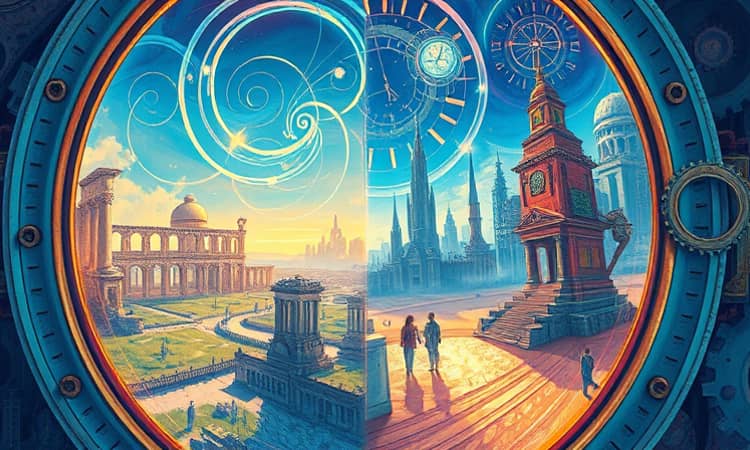
Imagine looking into a mirror that doesn't just show your face, but reveals the entire tapestry of human history, woven with patterns that repeat like the turning of seasons.
This cyclical nature of existence is a profound truth, one that has fascinated philosophers, scientists, and seekers for millennia, offering a key to unlocking future insights through past reflections.
By embracing this perspective, we can transform uncertainty into opportunity, using the past as a guide to navigate the complexities of modern life and inspire personal and societal growth.
The Ancient Echoes: A History of Mirrors and Their Symbolism
Mirrors have always been more than mere objects; they are portals to deeper understanding, reflecting our innermost selves and the world around us.
From prehistory, when early humans saw their reflection in calm water, sparking the dawn of self-awareness, mirrors have symbolized the quest for knowledge and truth.
In ancient times, mirrors made of obsidian or metal were used in rituals, believed to bridge the visible and invisible realms, a concept that resonates with today's search for meaning.
- Origins: Recognition of the self in natural reflections, marking the emergence of consciousness.
- Antiquity: Ritual use in cultures like those of Euclides and Arquimedes, who explored optics and reflection.
- Renaissance: Mirrors became symbols of duality, beauty, and the fleeting nature of life, reflecting human-centric values.
Spiritual traditions further enriched this symbolism, with Buddhism seeing mirrors as emblems of clarity and the interstice between life and rebirth.
- Buddhism: Mirrors represent the mutual reflection of enlightenment and the path to self-realization.
- Hinduism: Used in protective rituals and philosophical debates on the nature of the Self.
Modern optics has elevated mirrors to tools of precision, with parabolic mirrors focusing waves of light, sound, and radio, much like how we can focus historical insights to illuminate the future.
This journey from primitive reflection to advanced technology underscores the mirror's role as a metaphor for cyclical learning and growth.
Cycles of Time: Understanding Historical and Social Patterns
History is not a straight line but a spiral, where events and trends echo across generations, forming predictable cycles that can guide our foresight.
Theories like those of Kondratiev and Strauss-Howe reveal repetitive economic and social phases, such as periods of growth, awakening, unraveling, and crisis.
By studying these patterns, we can anticipate shifts in technology, politics, and culture, turning historical knowledge into a practical compass for decision-making.
Other cycles, like those of centralization-decentralization or value regime changes, show how societies oscillate between stability and dynamism, much like the reflection in a mirror that alternates between clarity and distortion.
- Patterns in the U.S.: Crisis events spaced approximately 80-100 years apart, from the American Revolution to modern upheavals.
- Global Examples: Rome's evolution from wilderness to oppressive city, mirroring cycles of growth and decay.
These cycles are not deterministic but offer frameworks for understanding, helping us recognize when we are in a phase of innovation or caution.
Psychological and Optical Metaphors: The Mirror Within and Without
The mirror effect in psychology teaches us that we often project our unacknowledged insecurities onto others, creating cycles of conflict and growth.
This process fosters self-awareness and empathy, as described by thinkers like Lacan, who saw mirror recognition in childhood as foundational to identity.
- Psychological Insights: Projecting inner turmoil onto external situations, leading to repetitive relational patterns.
- Optical Analogies: Parabolic mirrors focusing parallel waves to a point, symbolizing how past events converge to shape the present.
Interference patterns in optics, with cycles of constructive and destructive intensity, mirror the ebb and flow of historical trends, where ideas clash and coalesce over time.
By applying these metaphors, we can better navigate personal and collective challenges, using reflection to break negative cycles and amplify positive ones.
Practical Applications: Using Cyclical Insights for Prediction and Growth
To harness the power of cyclical mirrors, start by studying historical data and identifying recurring themes in your own life or society.
This isn't about fatalism but empowerment, allowing you to anticipate changes and adapt proactively, turning potential crises into opportunities for renewal.
- Step 1: Analyze past events in your field or personal history to spot patterns.
- Step 2: Compare these to established cycles like Kondratiev waves or generational turnings.
- Step 3: Use this knowledge to make informed decisions, such as investing during growth phases or preparing for societal shifts.
For example, recognizing that we are in a Fourth Turning crisis period can inspire community-building and innovation, much like how post-war eras led to reconstruction.
Technological advancements, driven by cycles of innovation, offer tools for sustainable development, with AI and renewables marking a new Kondratiev wave.
Embrace self-reflection through journaling or meditation, using the mirror as a tool for personal growth, to avoid repeating mistakes and foster resilience.
- Daily Practices: Reflect on daily actions to identify cyclical habits and break negative loops.
- Long-term Planning: Align goals with historical trends, such as focusing on education during learning cycles.
By integrating these approaches, you can create a life that is not only reactive but visionary, drawing on the past to craft a brighter future.
Conclusion: Embracing the Cyclical Journey
In the end, the cyclical mirror reminds us that history is a teacher, not a jailer, offering lessons that can illuminate our path forward.
By reflecting on the past with curiosity and courage, we can foresee challenges and seize opportunities, transforming uncertainty into a canvas for creation.
Let this understanding inspire you to look deeper, think cyclically, and act with wisdom, knowing that every reflection holds the promise of a new beginning.